

Learn how the skills gap affects businesses and job seekers, and how tech upskilling helps companies build stronger teams, improve productivity, and stay competitive.
The modern labor market is changing faster than many companies and workers can keep up with. Across industries, employers are struggling to find people with the right skills, while many job seekers are struggling to secure good roles despite having degrees, work experience, or professional ambition. This mismatch is known as the skills gap, and it has become one of the biggest challenges facing today’s workforce.
The skills gap happens when the skills employers need are different from the skills available in the job market. In practical terms, a company may need data analysts, cloud engineers, cybersecurity specialists, software developers, product managers, digital marketers, automation experts, or AI-literate employees, but the available candidates may not have enough practical experience in those areas. At the same time, many workers may be hardworking and educated, but their skills may no longer match what modern employers require.
This problem is not limited to technology companies. Banks, hospitals, insurance companies, logistics firms, schools, government agencies, manufacturing companies, e-commerce businesses, and even small businesses now depend on technology to operate effectively. As digital tools become central to everyday business, the demand for tech skills continues to grow.
The solution is not simply to hire more people. The real solution is tech upskilling.
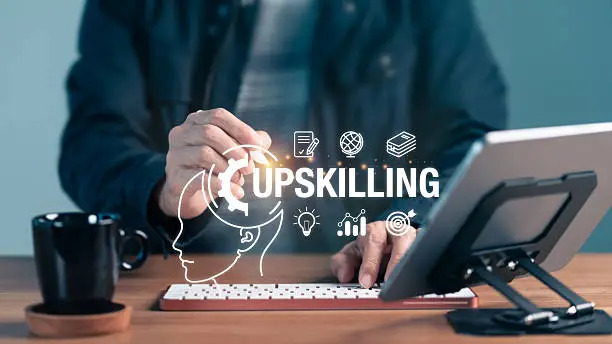
Tech upskilling means helping people learn new technology-related skills or improve the ones they already have. It allows employees to become more useful in their current roles, helps job seekers become more employable, and enables companies to build the workforce they need instead of waiting endlessly for perfect candidates to appear.
For job seekers looking for better roles, platforms like Delon Jobs can help connect skilled candidates with employers. For companies and professionals interested in structured technology training, Delon Academy provides practical upskilling support for the modern workforce.
Understanding the Skills Gap
The skills gap is not just about unemployment. In many countries, including Nigeria, there are many people looking for jobs, but employers still complain that they cannot find qualified candidates. This shows that the problem is not always the number of people available; it is often the quality, relevance, and practicality of their skills.
A graduate may have studied computer science, but may not know how to build a real production-ready application. An accountant may understand financial reporting but may not know how to use modern accounting software, data dashboards, or automation tools. A customer service professional may communicate well but may not know how to use CRM systems, ticketing platforms, or AI-assisted support tools. A project manager may understand coordination but may not know Agile, Scrum, Jira, product documentation, or digital project workflows.
The World Economic Forum’s Future of Jobs Report 2025 highlights how technology, economic shifts, and workforce transformation are changing jobs and skills globally. The report is based on the views of more than 1,000 employers representing over 14 million workers across 55 economies, showing how serious and global the issue has become.
The skills gap is therefore not a future problem. It is already affecting hiring, productivity, innovation, and business growth.
Why the Skills Gap Is Getting Worse
Several forces are making the skills gap wider.
1. Technology Is Changing Faster Than Education
Traditional education systems often take years to update their curriculum. But technology changes every few months. New programming frameworks, cloud tools, AI platforms, cybersecurity threats, analytics systems, and automation tools are constantly emerging.
This creates a delay between what schools teach and what employers need. By the time many students graduate, some of the tools and practices they learned may already be outdated.
This does not mean formal education is useless. Degrees still matter in many fields. However, degrees alone are no longer enough. Employers increasingly want candidates who can demonstrate practical, job-ready skills.
2. Many Jobs Now Require Digital Skills
Digital skills are no longer limited to IT departments. Almost every department now uses technology.
Human resources teams use HR software, payroll systems, applicant tracking systems, and analytics dashboards. Finance teams use accounting software, ERP platforms, Excel automation, and data visualization tools. Sales teams use CRM systems, lead management platforms, and digital prospecting tools. Marketing teams use SEO tools, social media platforms, analytics, email automation, and paid advertising dashboards.
This means that even non-technical professionals now need some level of digital competence.
The World Economic Forum notes that technological skills are expected to grow in importance faster than any other skill category in the coming years, with AI, big data, networks, cybersecurity, and technological literacy becoming especially important.
3. Employers Need Practical Experience, Not Just Theory
One of the biggest complaints from employers is that many candidates know theory but cannot apply it.
For example, a company hiring a UI/UX designer may not only want someone who understands design principles. They want someone who can conduct user research, create wireframes, build prototypes in Figma, test designs, and present a strong portfolio.
A company hiring a software developer may not only want someone who knows JavaScript. They want someone who can write clean code, work with APIs, use Git, understand deployment, collaborate with a team, and solve real business problems.
A company hiring a data analyst may not only want someone who studied statistics. They want someone who can clean data, write SQL queries, use Excel or Power BI, interpret dashboards, and communicate insights clearly.
This is why practical upskilling is so important.
How the Skills Gap Affects Companies
The skills gap creates serious business problems.
1. Hiring Takes Longer
When companies cannot find qualified candidates, recruitment becomes slow and expensive. HR teams spend more time screening applications, interviewing candidates, and restarting recruitment processes.
This delays business operations. Projects are postponed. Existing employees become overworked. Managers become frustrated. Customers may experience slower service.
2. Productivity Declines
When employees lack the right skills, tasks take longer than necessary. Work becomes manual, repetitive, and error-prone.
For example, a finance team without strong spreadsheet or accounting software skills may spend days preparing reports that could be automated. A customer service team without CRM training may lose track of customer issues. A marketing team without analytics skills may continue running campaigns without knowing what is working.
In contrast, upskilled employees use tools better, solve problems faster, and reduce waste.
3. Innovation Slows Down
Companies with outdated skills struggle to innovate. They may know what they want to achieve but lack the internal capability to build, automate, analyze, or improve systems.
A business may want to launch a mobile app, automate payroll, use AI for customer service, improve cybersecurity, or analyze customer behavior, but without the right talent, these ideas remain plans instead of becoming real solutions.
4. Companies Become Too Dependent on External Consultants
When internal teams lack modern skills, companies often rely heavily on external consultants. While consultants can be useful, overdependence can become costly.
A company that upskills its internal team becomes stronger. Employees understand the organization’s systems, customers, and processes better than outsiders. When they are trained properly, they can solve problems faster and maintain solutions more sustainably.
How the Skills Gap Affects Job Seekers
The skills gap also affects individuals.
Many job seekers apply for roles but receive no response because their CVs do not show the skills employers need. Others attend interviews but fail technical assessments. Some get jobs but struggle to perform because they lack practical exposure.
This is why job seekers must stop relying only on qualifications. They must build evidence of skill.
For example:
A software developer should have GitHub projects.
A UI/UX designer should have a portfolio.
A data analyst should have dashboards and case studies.
A digital marketer should have campaign examples.
A product manager should have product requirement documents, roadmaps, user stories, or case studies.
A cybersecurity beginner should have labs, certifications, or practical exercises.
Candidates who can show real work stand out more than those who only list skills on their CV.
Job seekers can explore opportunities and understand market expectations through Delon Jobs, especially when preparing for roles in technology, product, finance, operations, and digital business.
What Tech Upskilling Really Means
Tech upskilling is not just about learning how to code. Coding is important, but technology skills extend beyond software development.
Tech upskilling can include:
- Data analysis
- Cloud computing
- Cybersecurity
- Software development
- UI/UX design
- Product management
- Agile and Scrum
- Digital marketing
- Business analysis
- AI tools and prompt engineering
- Automation tools
- CRM and ERP systems
- HR and payroll software
- Accounting technology
- Technical writing
- Quality assurance testing
The goal of tech upskilling is to help people become more effective in a digital workplace.
For a finance professional, upskilling may mean learning Power BI, advanced Excel, accounting software, and automation.
For an HR professional, it may mean learning HRIS platforms, payroll systems, recruitment software, and people analytics.
For a project manager, it may mean learning Jira, Confluence, Agile, Scrum, and product delivery frameworks.
For a business owner, it may mean understanding digital tools that reduce cost, improve reporting, and increase visibility.
How Tech Upskilling Solves the Skills Gap
1. It Converts Existing Employees into Future-Ready Talent
Hiring new employees is not always the best or fastest solution. Many companies already have loyal, hardworking employees who understand the business. What they lack is updated technical knowledge.
Upskilling helps companies transform existing employees into more capable contributors.
For example, an operations officer can learn data analysis and become useful in reporting. A customer service representative can learn CRM tools and become a support operations specialist. A manual payroll officer can learn HR and payroll software and become more efficient.
This approach saves time, reduces hiring pressure, and improves employee loyalty.
McKinsey argues that employers can play a larger role in upskilling by reducing common barriers such as lack of time and money, and by creating pathways that help workers move into better-skilled roles.
2. It Makes Job Seekers More Employable
Upskilling helps candidates close the gap between what they know and what employers need.
A graduate who learns software testing, data analytics, or UI/UX design becomes more employable. A non-technical professional who learns digital tools becomes more valuable. An entry-level worker who builds practical projects becomes more competitive.
This is especially important in markets where many applicants compete for limited roles. Candidates who invest in practical tech skills increase their chances of getting shortlisted, interviewed, and hired.
3. It Improves Business Productivity
Upskilled employees work faster and smarter.
They can automate reports, use dashboards, troubleshoot systems, reduce manual errors, and collaborate better. This directly improves productivity.
McKinsey has reported that analysis of millions of job postings shows a wide gap between demand for high-demand tech skills and the number of candidates who have them, reinforcing why companies must develop these capabilities internally instead of relying only on external hiring.
4. It Supports Digital Transformation
Many companies say they want digital transformation, but digital transformation cannot succeed without skilled people.
Buying software is not enough. A company may purchase an ERP system, HR software, CRM, cloud platform, or analytics tool, but if employees do not know how to use it properly, the investment will fail.
Tech upskilling ensures that employees can use digital tools effectively. It turns technology from an unused expense into a real business advantage.
5. It Helps Companies Compete Better
Companies with skilled employees move faster. They respond to customer needs faster. They analyze data better. They launch products faster. They reduce errors. They improve service delivery.
This gives them an advantage over competitors that are still operating manually or struggling with outdated skills.
In competitive industries, the company with the better-skilled workforce often wins.
The Most Important Tech Skills for Closing the Skills Gap
1. Data Analysis
Data analysis is one of the most useful skills in today’s workplace. Companies need employees who can interpret data, identify trends, and support decision-making.
Important tools include Excel, SQL, Power BI, Tableau, Python, and Google Analytics.
2. Artificial Intelligence Literacy
AI is changing how work is done. Employees do not all need to become AI engineers, but they need to understand how AI tools can support writing, research, automation, customer service, reporting, and decision-making.
AI literacy is becoming a workplace advantage.
3. Cybersecurity Awareness
As businesses become more digital, cybersecurity risks increase. Employees need to understand phishing, password security, data protection, device safety, and secure system usage.
Cybersecurity is not only the responsibility of IT teams. Every employee has a role to play.
4. Cloud Computing
Cloud platforms help businesses store data, run applications, collaborate remotely, and scale operations. Skills in AWS, Microsoft Azure, Google Cloud, and cloud security are increasingly valuable.
5. Software Development
Software development remains one of the strongest tech career paths. Skills in JavaScript, Python, React, Node.js, Java, C#, PHP, and mobile development continue to be useful.
6. UI/UX Design
As companies build websites, apps, portals, and digital products, they need designers who understand user experience. UI/UX skills help businesses create products that customers can use easily.
7. Product Management
Product managers help companies build the right digital products. They connect business goals, customer needs, and technical execution.
Important skills include road mapping, user research, backlog management, Agile, stakeholder communication, and product analytics.
8. Digital Marketing
Companies need visibility online. Digital marketing skills such as SEO, content marketing, paid ads, email marketing, social media strategy, and analytics are essential for growth.
Why Companies Should Build a Learning Culture
Upskilling should not be treated as a one-time event. It should become part of company culture.
Learning culture means employees are encouraged to improve continuously. Managers support training. Teams share knowledge. Employees are rewarded for learning and applying new skills.
LinkedIn’s Workplace Learning Report highlights how large organizations are using skill assessments, gap analysis, and personalized learning recommendations to support upskilling and reskilling at scale.
Companies that build this kind of culture become more adaptable. When new tools emerge, they adjust faster. When business needs change, they respond better. When competitors struggle, they keep moving.
How Employers Can Start Tech Upskilling
Companies do not need to start with a massive budget. They can begin with simple steps.
First, identify the skills the business needs. This may include data analysis, cloud tools, cybersecurity, CRM usage, software development, AI literacy, or digital marketing.
Second, assess current employees to know the existing skill level.
Third, group employees based on learning needs.
Fourth, create practical training plans.
Fifth, ensure employees apply what they learn to real company problems.
Sixth, measure outcomes such as productivity, speed, error reduction, customer satisfaction, and revenue impact.
Companies can partner with training providers such as Delon Academy to create practical learning programs for employees, interns, graduates, and technical teams.
How Job Seekers Can Start Closing Their Own Skills Gap
Job seekers should not wait for employers to train them. They should take responsibility for their own growth. Explore Delon Academy tech training programs
A practical approach is to choose one career direction and build relevant skills around it.
For example:
If you want to become a frontend developer, learn HTML, CSS, JavaScript, React, Git, APIs, and deployment.
If you want to become a data analyst, learn Excel, SQL, Power BI, statistics, and storytelling with data.
If you want to become a UI/UX designer, learn user research, wireframing, Figma, prototyping, usability testing, and portfolio presentation.
If you want to become a Scrum Master, learn Agile principles, Scrum ceremonies, Jira, team facilitation, conflict resolution, and delivery reporting.
If you want to become a digital marketer, learn SEO, content strategy, paid advertising, analytics, email marketing, and social media management.
Learning should be practical. Build projects. Create samples. Volunteer. Take internships. Document your progress. Update your CV and LinkedIn profile. Apply for roles through platforms like Delon Jobs.
Conclusion
The skills gap is one of the most important workforce challenges of our time. It affects employers, employees, job seekers, and entire economies. Companies need skilled workers, but many available candidates do not yet have the practical digital and technical skills required for modern roles.
Tech upskilling solves this problem by helping employees become more productive, helping job seekers become more employable, and helping companies build stronger teams. It turns ambition into capability. It turns education into practical value. It turns ordinary workers into future-ready professionals.
The future of work will reward people and companies that learn continuously. Businesses that invest in tech upskilling will innovate faster, hire smarter, retain better talent, and compete more successfully. Job seekers who upskill will have better opportunities, stronger CVs, and more confidence in the labor market.
The time to act is now. Companies should start training their workforce before competitors take the lead, and job seekers should start building practical tech skills before the best opportunities pass them by. Visit Delon Jobs to explore career opportunities and connect with skilled talent, and visit Delon Academy to begin practical tech upskilling today. The skills gap will not close by itself; it will only close when people and organizations take action.
Suggested Reads

 Teniola Makinde
Software Engineering Training in Nigeria: What You Should Know
 Teniola Makinde
Best Tech Skills to Learn in Nigeria in 2026
 Teniola Makinde
Enterprise Technology Training in Nigeria: A Complete Guide
 Anuoluwapo Owonibi
Why Companies Must Invest in Tech Upskilling to Stay Competitive in the Digital Era
 Anuoluwapo Owonibi
Why Enterprise Tech Upskilling Is a Business Necessity
 Anuoluwapo Owonibi
Why Businesses Need Skilled Software Developers More Than Ever
 Anuoluwapo Owonibi
Career Switch in 2026: How to Transition into Tech Without Starting Over
 Bamidele Ashade
How Tech Upskilling Helps Businesses Improve Productivity and Reduce Costs
 Bamidele Ashade
The ROI of Employee Upskilling Programs
 Bamidele Ashade
How Tech Upskilling Can Help Professionals Earn More and Stay Relevant
 Bamidele Ashade
Bridging the Gap Between Education and Employment Through Tech Skills
 Bamidele Ashade
Why Africa’s Young Workforce Must Embrace Tech Skills to Compete Globally
 Bamidele Ashade
You Don’t Need to Code: The Tech Skills Every Professional Should Have in 2026
Bamidele Ashade
The Skills Gap Problem, and How Tech Upskilling Solves It.
 Ashade Bamidele
Discover Why Companies That Invest in Tech Upskilling Outperform Their Competitors
 Bamidele Ashade
Upskill to Not Become Obsolete
 Bamidele Ashade
The Importance of Tech Skills in Today's Labor Market
 Anuoluwapo Owonibi
Why Most Beginners Struggle to Learn Tech Skills – And How Structured Training Changes Everything
 Bamidele Ashade
Shape UI/UX Design in Practice: How to Build Real Projects That Get You Hired
 Anuoluwapo Owonibi
How to Start a Career in Product Management with No Experience | Beginner Guide
 Khodijah Badmus
AI Tools That Can Help You Learn Tech Faster
 Khodijah Badmus
How to Train Non-Technical Staff (e.g. PMs, Sales) in Basic Software Literacy
 Anuoluwapo Owonibi
From Beginner to Designer: Step-by-Step Guide to Learning UI/UX Design in 2025
 Abimbola Kazeem
Quality Assurance (QA) Training: Learn Software Testing with Cypress, Selenium & JMeter
 Anuoluwapo Owonibi
The Power of Upskilling: Why Continuous Learning Matters in 2025
 Abimbola Kazeem
How to Start a Career in Data Analytics With No Experience | Beginner Guide
 Abimbola Kazeem
Top In-Demand Tech Skills to Learn in 2025: Stay Ahead of the Career Curve
 Khodijah Badmus
10 Mistakes Coding Newbies Make and How to Avoid Them
 Abimbola Kazeem
Why Software & Data Skills Are Critical for Nigeria’s Economy
 Khodijah Badmus
Top 10 Tech Skills in 2025 That Can Earn You Close to 7 Figures Monthly
 Khodijah Badmus
What Recruiters Look for in Junior Developers
 Badmus Khodijah
Digital Skills Every Nigerian Youth Should Learn Before 2030
 Badmus Khodijah
How to Apply for International Scholarships as a Nigerian Student in 2025
 Badmus Khodijah
Best Part-Time Jobs for Nigerian Students That Pay Well
 Badmus Khodijah
Best Courses to Study in Nigeria for High-Paying Jobs After Graduation
 Badmus Khodijah
Backend, Frontend, or Fullstack? Choosing Your Developer Path
 Kazeem Aboaba
How to Reskill Staff with In-Demand IT Expertise
 Kazeem Aboaba
How to Upskill Your Enterprise Workforce Effectively
 Badmus Khodijah
7 Tech Roles That Don't Require a Computer Science Degree
 Kazeem Aboaba
Learn the Skills Employers Want in Developers
 Badmus Khodijah
How to Deploy Your First Web App without Losing Your Mind
 Kazeem Aboaba
Master Enterprise Software Skills for Career Growth
 Kazeem Aboaba
Building Real-World Projects That Impress Employers
 Badmus Khodijah
Online vs On-Site Coding Bootcamps: What's Right for You?
 DelonApp
Blog Article 1
Delon App
Blog Article 2
Testing